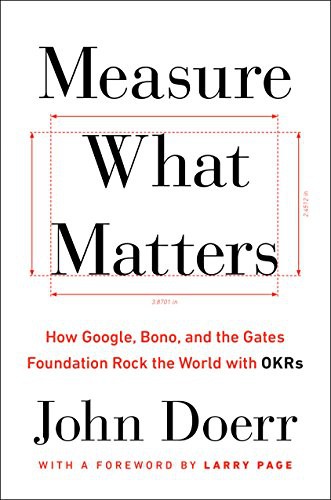
Measure What Matters
The goal-setting system behind Google's growth, from the source.
by John Doerr · 2018
Share on XDoerr, a venture capitalist who introduced Google to the OKR (Objectives and Key Results) framework early in its history, lays out the goal-setting system credited with shaping the discipline of some of the most successful companies in tech.
The book mixes Doerr's own account of bringing OKRs to Google with case studies from other organizations — Intel, where OKRs originated, the Gates Foundation, and others — showing the framework applied at different scales.
It's as much a business-history and case-study collection as an instructional manual, so readers wanting a pure how-to guide may need to extract the practical steps from the surrounding narrative; the core framework itself is simple enough to summarize in a paragraph.
Doerr is careful to separate OKRs from performance reviews — a distinction a lot of companies that adopt the framework blur, to its detriment. His argument is that OKRs work as an aspirational, transparent goal-tracking tool precisely because they aren't tied to compensation or evaluation; the moment they become a scorecard for individual performance, people stop setting ambitious targets and start sandbagging.
Key ideas
- Doerr introduced Google to the OKR (Objectives and Key Results) framework early in its history — the system credited with shaping some of tech's most successful companies.
- OKRs stop working the moment people start sandbagging them to protect their performance review.
- OKRs work as an aspirational, transparent goal-tracking tool precisely because they aren't tied to compensation or evaluation.
- It's as much a business-history and case-study collection — Intel, the Gates Foundation — as an instructional manual.
Notable quote: “Ideas are easy. Execution is everything.” — John Doerr