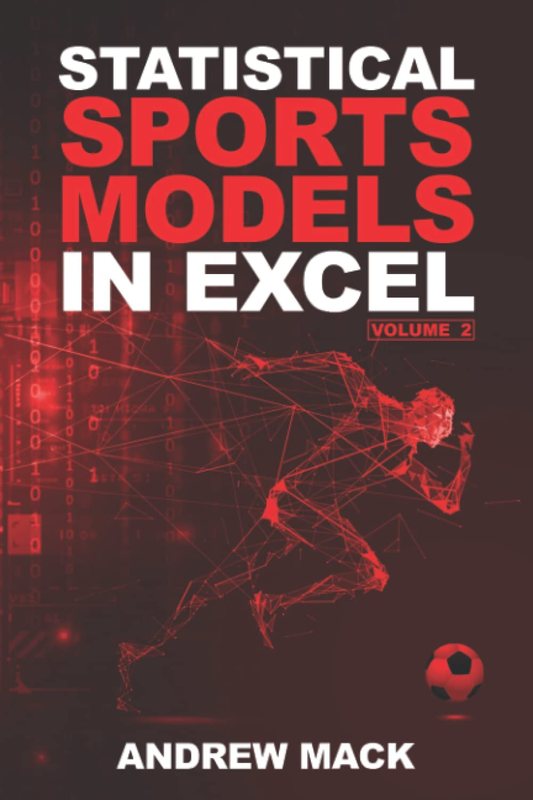
Statistical Sports Models in Excel
Building your own sports prediction models with nothing but Excel.
by Andrew Mack · 2019
Share on XMost sports-analytics books ask you to trust the math; Mack's pitch is that you can build the models yourself, in software you probably already have open at work.
It's a genuine crash course — team-level (not player-level) prediction models across NFL, NBA, NHL, AFL, and the Premier League, built around regression rather than anything requiring a stats degree, with downloadable companion spreadsheets so you're working alongside the book rather than just reading about it.
Readers consistently rate it well for what it is — an accessible on-ramp — though a few note it explains the “how” of building the spreadsheets more than the “why” behind the underlying statistics, so pair it with something more theoretical if you want the deeper math.
The choice to build team-level rather than player-level models is deliberate and worth understanding before you start — it keeps the math tractable in a spreadsheet (regression on team stats) rather than requiring the kind of computing power and data access player-level projection systems need, which is exactly the tradeoff that makes this approachable for a reader without a stats background.
Key ideas
- Most sports-analytics books ask you to trust the math; Mack's pitch is that you can build the models yourself in software you probably already have open.
- You don't need player-level data or a stats degree to build a genuinely useful team prediction model — you need the right team-level inputs and a spreadsheet.
- It covers team-level prediction models across NFL, NBA, NHL, AFL, and the Premier League, built around regression rather than anything requiring a stats degree.
- It explains the "how" of building the spreadsheets more than the "why" behind the underlying statistics — pair it with something more theoretical for the deeper math.