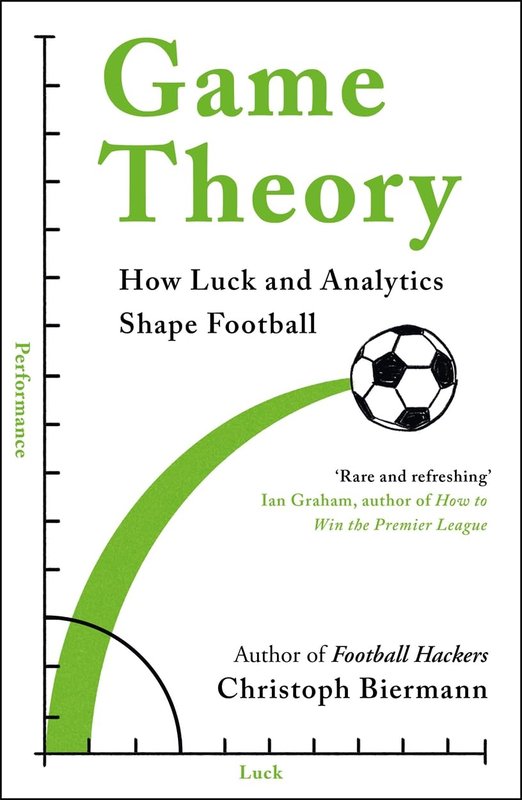
Game Theory
Why chance, not just talent or tactics, decides more football matches than anyone wants to admit.
by Christoph Biermann · 2026
Share on XBiermann's central claim is that football's obsession with tactics and talent evaluation understates the role of pure chance — a low-scoring sport where a handful of bounces and refereeing calls can swing a season, and the clubs that understand this variance make better decisions than the ones chasing narrative explanations for results.
Drawing on interviews with coaches, club owners, and the analytics staff behind some of Europe's most data-driven clubs, he traces how expected-goals models and other luck-adjusted metrics let clubs separate skill from randomness, and why the most sophisticated data departments increasingly manage risk rather than chase certainty.
The reporting and the interviews are the book's real strength; some of the underlying statistical explanations move fast for anyone not already comfortable with expected goals or regression to the mean.
What sets this apart from a straightforward stats primer is Biermann's insistence that variance isn't just noise to be modeled away — it's something clubs have to build organizational processes around, from how they evaluate managers after a bad run of results to how they price transfer risk. The book's more interesting chapters are less about the math itself and more about the psychological discipline of trusting a process through a losing streak that the numbers say was still the right decision.
Key ideas
- The clubs that win consistently are usually the ones that have made peace with how much of any single result is luck.
- Expected-goals and other luck-adjusted metrics let clubs separate skill from randomness in a way raw results never can.
- Sophisticated data departments increasingly manage risk rather than chase certainty — treating variance as something to plan around, not eliminate.
- Trusting a process through a losing streak the numbers still endorse is a psychological discipline, not just a modeling one.