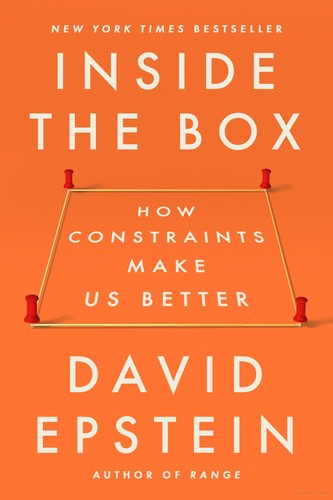
Inside the Box
Why limits sharpen thinking better than unlimited options do.
by David Epstein · 2026
Share on XThis book takes on a counterintuitive idea: that limitations — of time, resources, information, or freedom — often produce better thinking and better outcomes than having unlimited options, because constraints force real prioritization instead of endless optimization.
It draws on research across psychology, design, and decision-making to show how removing choices can sharpen judgment rather than merely restrict it, echoing themes familiar from other behavioral-science books on this shelf.
As with much of this genre, the argument occasionally outruns the evidence in its more sweeping claims, and some case studies work better as illustration than as proof; it's most convincing when it stays close to specific, well-documented examples.
Epstein is careful to distinguish productive constraints from arbitrary ones — a strict deadline that forces prioritization is different from a bureaucratic rule that just adds friction — and the book spends real time on how to design the former rather than stumble into the latter. The most useful chapters treat constraint-setting as a skill in its own right, not just a fact of life to be endured.
Key ideas
- Limitations of time, resources, or freedom often produce better thinking than unlimited options, because constraints force real prioritization instead of endless optimization.
- The right constraint doesn't limit your options so much as it tells you which ones actually matter.
- Productive constraints are designed, not just endured — a strict deadline that forces prioritization is different from a bureaucratic rule that just adds friction.
- The book is most convincing when it stays close to specific, well-documented case studies rather than its more sweeping claims.