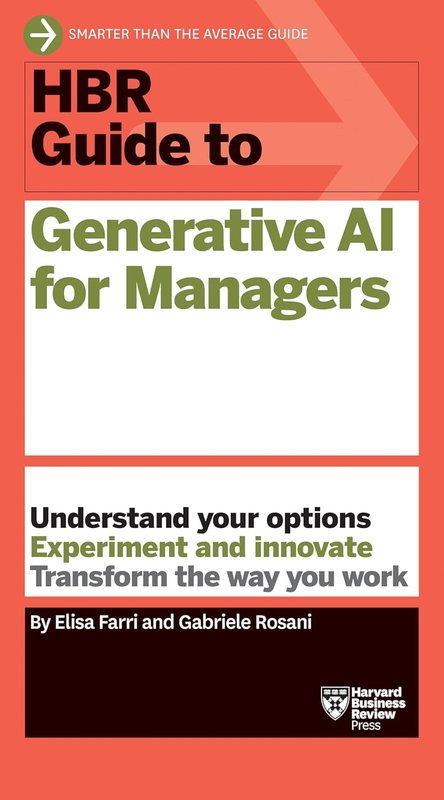
HBR Guide to Generative AI for Managers
A grounded guide to what generative AI actually changes about managing people.
by Elisa Farri, Gabriele Rosani · 2025
Share on XFarri and Rosani write a practical, Harvard Business Review-style guide to what generative AI actually changes about managing a team — not the hype cycle, but the concrete decisions: which tasks to delegate to a model, how to redesign workflows around it, and how to keep judgment and accountability with people rather than letting them quietly evaporate into a tool.
It's structured like other HBR guides — short, scannable chapters built around specific manager-facing scenarios rather than a single sustained argument, which makes it easy to reference rather than read cover to cover.
Because generative AI tools and best practices are moving quickly, some specifics will age faster than the underlying management principles; treat the frameworks for delegation and oversight as the durable part, and the tool-specific advice as a snapshot of this moment.
The most practically useful sections aren't about the tools at all — they're the frameworks for deciding what to keep human: which decisions need a person's judgment attached for accountability reasons, and which are genuinely fine to delegate. That distinction, more than any specific prompting technique, is the part likely to still matter once the current generation of AI tools is obsolete.
Key ideas
- The real management question isn't what the model can do — it's what you're willing to be accountable for if you let it.
- The most useful frameworks are about deciding what to keep human, not about specific prompting techniques.
- It's structured like other HBR guides — short, scannable chapters built around manager-facing scenarios rather than one sustained argument.
- Because AI tools move quickly, treat the delegation and oversight frameworks as durable and the tool-specific advice as a snapshot of this moment.