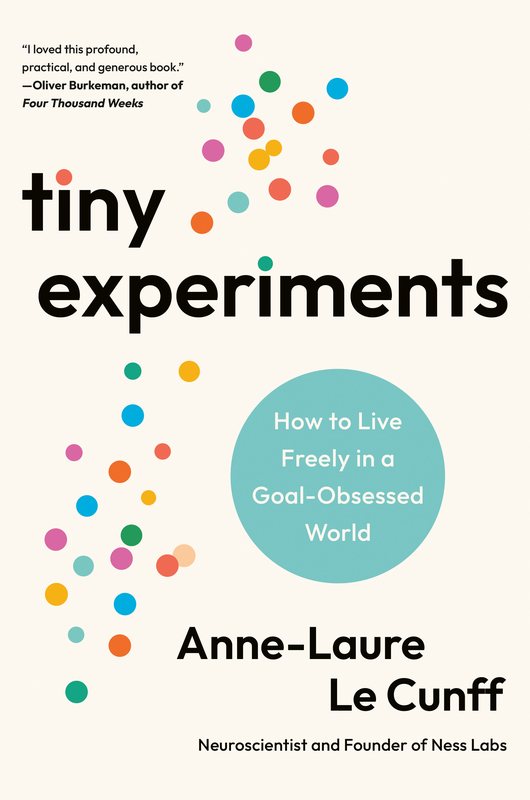
Tiny Experiments
Treating your life and career as small experiments instead of fixed plans.
by Anne-Laure Le Cunff · 2025
Share on XAnne-Laure Le Cunff — who writes the Ness Labs newsletter on neuroscience-informed productivity — makes a case in Tiny Experiments against the fixed, rigid goal-setting most self-help defaults to. Her alternative: treat life decisions as small, low-stakes experiments with a hypothesis and a review point, rather than as commitments you either heroically achieve or fail at.
The appeal is the framing more than any single technique — it takes the pressure off big, identity-defining goals (“I will become a runner”) and replaces it with something more forgiving and more scientific (“I’ll try running three times this week and see how it actually feels”). That reframe alone changes how failure feels, since an experiment that doesn’t pan out is data, not a verdict on you.
It sits in a similar space to a lot of behavioral-science-adjacent self-help, but grounded more explicitly in actual neuroscience research than most of the genre, which gives it a bit more backbone than the average goal-setting book.
Le Cunff's neuroscience framing isn't just decoration — she connects the experiment-and-review cycle to how the brain actually updates on new information, arguing that rigid goals create an all-or-nothing response while flexible experiments keep motivation intact even when a given attempt doesn't pan out. That mechanism is what separates this from a purely motivational reframe.
Key ideas
- Treating a goal as an experiment protects your motivation from any single result.
- Le Cunff replaces fixed, identity-defining goals with small, low-stakes experiments that have a hypothesis and a review point.
- The neuroscience framing isn't just decoration — rigid goals create an all-or-nothing response, while flexible experiments keep motivation intact after a setback.
- It's grounded more explicitly in actual neuroscience research than most goal-setting self-help, giving it more backbone than the average entry in the genre.