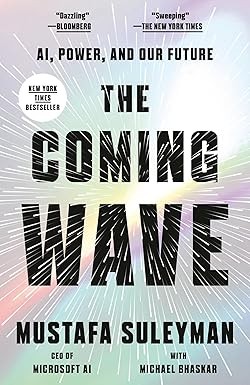
The Coming Wave
Technology, Power, and the Twenty-First Century's Greatest Dilemma
by Mustafa Suleyman, Michael Bhaskar · 2023
Share on XSuleyman's argument is that a wave of cheap, general-purpose technologies — frontier AI foremost among them, alongside synthetic biology and other fields — is about to become so powerful and so accessible that the usual tools states use to contain dangerous technology no longer work.
Writing as a co-founder of DeepMind and later Inflection AI, he treats containment as the defining political problem of the next decade, walking through why open proliferation, concentrated corporate power, and outright state control all fail as solutions on their own.
The diagnosis is more convincing than the prescription — the book is stronger at explaining why containment is hard than at offering a workable plan for it, and some of the sweeping historical framing does more rhetorical work than analytical work.
Suleyman is most persuasive describing the specific failure mode of every previous containment strategy — nuclear-style state monopolies don't work when the technology is software, open-source norms don't work when the technology is dangerous by default, and corporate self-regulation doesn't work when the competitive pressure to ship is stronger than the incentive to slow down. Stacking those failures up is the book's real contribution, even where his own proposed alternative stays comparatively vague.
Key ideas
- A wave of cheap, general-purpose technologies — frontier AI foremost — is becoming powerful and accessible enough that the usual tools states use to contain danger no longer work.
- Every strategy that worked for containing past dangerous technologies breaks down against something this cheap to copy.
- Nuclear-style state monopolies, open-source norms, and corporate self-regulation all fail as standalone containment solutions.
- The diagnosis is more convincing than the prescription — the book is stronger at explaining why containment is hard than at offering a workable plan.