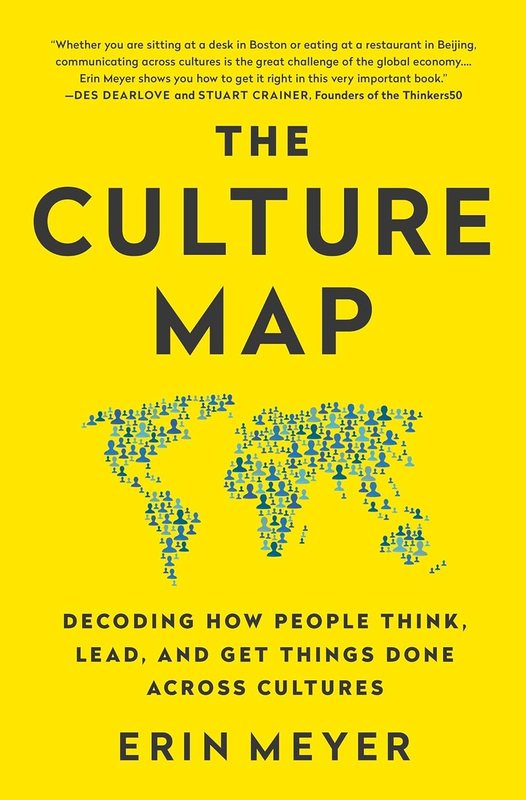
The Culture Map
Decoding How People Think, Lead, and Get Things Done Across Cultures
by Erin Meyer · 2014
Share on XMeyer's framework maps national business cultures across eight scales — communication, feedback, persuasion, leading, deciding, trusting, disagreeing, and scheduling — arguing that most cross-cultural friction at work comes from mismatched positions on these scales rather than differences in competence or intent.
Built from her INSEAD teaching and consulting work with multinational teams, the book pairs each scale with concrete stories of miscommunication and practical adjustments for working across them.
The eight-scale model is a genuine simplification of something messier in practice — individual variation within a country is often larger than the national average the book uses as a stand-in, so it works better as a starting vocabulary for noticing difference than as a precise predictive tool.
The scale that generates the most recognition in practice is 'disagreeing' — Meyer shows that some cultures treat open confrontation as healthy and honest while others read the same directness as aggressive or disrespectful, and teams that never make that difference explicit tend to blame individual personalities for what's actually a structural mismatch in communication norms.
Key ideas
- Most cross-cultural friction at work comes from mismatched positions on eight scales — communication, feedback, persuasion, leading, deciding, trusting, disagreeing, scheduling.
- Most cross-cultural workplace friction isn't a personality clash — it's two people using different, unstated rules for the same conversation.
- Some cultures treat open confrontation as healthy and honest, while others read the same directness as aggressive or disrespectful.
- The eight-scale model is a genuine simplification — individual variation within a country is often larger than the national average the book uses as a stand-in.