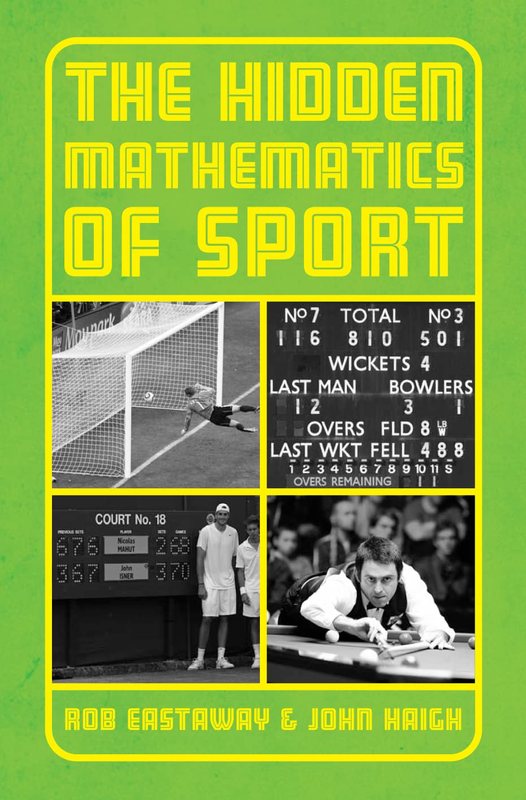
The Hidden Mathematics of Sport
The math quietly running underneath everyday sporting outcomes.
by Rob Eastaway, John Haigh · 2011
Share on XEastaway and Haigh's trick is keeping almost all the actual equations out of the main text — banished to an appendix — while still walking through genuinely rigorous ideas about probability and geometry across seventeen different sports.
The range is the appeal: football penalties and game theory, why certain points in tennis matter disproportionately more than others, the specific geometry behind dartboard strategy, record-breaking trends in athletics, and how league table scoring systems quietly shape the way teams play.
It's aimed at a general audience rather than sports-analytics obsessives specifically — reviewers note it works even for readers who don't especially follow sport, which also means it's less deep on any single topic than a dedicated book on that sport would be.
The dartboard chapter is a good example of the book's method — the standard numbering looks arbitrary until Eastaway and Haigh show it was actually designed to punish a slightly miscalibrated throw as severely as possible, deliberately placing high and low numbers next to each other so a small aiming error costs you the most points possible. That's the pattern across all seventeen sports: a rule or convention that looks arbitrary turns out to be quietly load-bearing once you do the math.
Key ideas
- Eastaway and Haigh keep almost all the actual equations out of the main text while walking through genuinely rigorous probability and geometry across seventeen sports.
- A lot of sport's "arbitrary" rules and traditions turn out to be doing careful mathematical work once you actually check.
- The standard dartboard numbering was designed to punish a slightly miscalibrated throw as severely as possible, placing high and low numbers next to each other.
- It's aimed at a general audience rather than sports-analytics obsessives, which also means it's less deep on any single topic than a dedicated book would be.