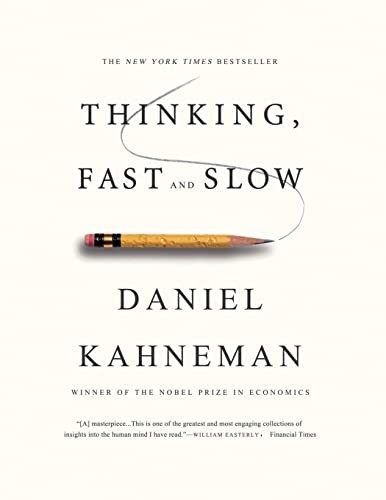
Thinking, Fast and Slow
The two-system mind, and the biases that creep in when instinct drives.
by Daniel Kahneman · 2011
Share on XKahneman, a Nobel laureate psychologist, lays out the two-system model of thought that has shaped a generation of thinking about decision-making: System 1, fast and intuitive, and System 2, slow and deliberate — and the long catalogue of biases that emerge when System 1 quietly runs the show.
It's the foundational text behind much of modern behavioral economics, and its influence shows up throughout the other decision-making books on this shelf.
It's a genuinely dense book — some chapters, particularly on prospect theory, demand real concentration — and its length means momentum can flag in the middle third; it rewards patience more than a single quick read.
The prospect theory chapters are the intellectual core, even where they're the hardest going — Kahneman's finding that people feel a loss roughly twice as intensely as an equivalent gain reshapes how you'd interpret almost any risk-related decision elsewhere on this shelf, from why bettors chase losses to why coaches make overly conservative in-game calls to protect a lead rather than press an advantage.
Key ideas
- Kahneman's two-system model — System 1, fast and intuitive, System 2, slow and deliberate — has shaped a generation of thinking about decision-making.
- People don't weigh gains and losses the same way — a loss hurts roughly twice as much as an equivalent gain feels good, and that asymmetry quietly shapes most risk decisions.
- It's the foundational text behind much of modern behavioral economics, and its influence shows up throughout the other decision-making books on this shelf.
- It's a genuinely dense book — the prospect theory chapters demand real concentration, and it rewards patience more than a single quick read.