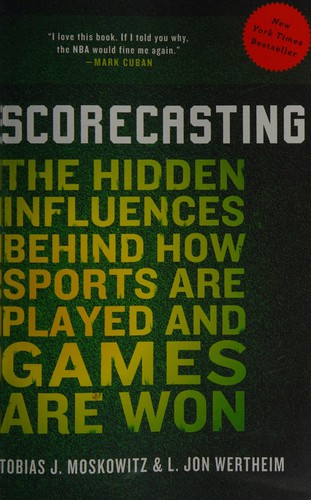
Scorecasting
Hidden incentives and biases quietly shaping outcomes across sports.
by Tobias Moskowitz, L. Jon Wertheim · 2011
Share on XWertheim and Moskowitz’s Scorecasting isn’t a football book specifically — it’s US-sports-heavy (NFL, NBA, MLB) — but it belongs on this shelf because the questions it asks translate directly: why does home advantage exist, and is it really about the crowd? Why do referees unconsciously favor the home team late in close games? Why do coaches make predictably conservative decisions even when the data says to be aggressive?
The home-field-advantage chapter is the one people remember. The authors build a strong case that it’s not crowd noise or travel fatigue driving the effect — it’s officiating bias, and specifically referees unconsciously avoiding decisions that will enrage a home crowd. That’s a genuinely unsettling idea once you’ve seen the evidence, and it recontextualizes a lot of “moments” fans attribute to atmosphere.
The chapters on coaching conservatism (why coaches punt on fourth down even when going for it is +EV) are the ones that map most directly onto football management — the same loss-aversion logic explains a lot of overly cautious substitutions and formations.
The officiating-bias evidence is more specific than a general suspicion of home-field advantage — Moskowitz and Wertheim find the effect concentrates in exactly the borderline, judgment-call decisions (a foul call, a close offside, a marginal penalty) where a referee has real discretion, and nearly disappears in objective calls the crowd can't meaningfully pressure, which is the detail that makes the unconscious-bias explanation hold up rather than just being a plausible story.
Key ideas
- The questions Scorecasting asks — why home advantage exists, why coaches make predictably conservative decisions — translate directly across sports, not just the US leagues it covers.
- Home advantage isn't mainly about the crowd inspiring the home team — it's about referees unconsciously avoiding the decisions that would enrage that same crowd.
- The bias concentrates in exactly the borderline, judgment-call decisions where a referee has real discretion, and nearly disappears in objective calls.
- The coaching-conservatism chapters — why coaches punt on fourth down even when going for it is +EV — map directly onto overly cautious in-game management in any sport.