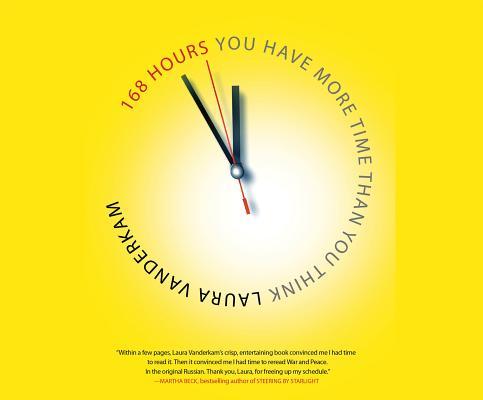
168 Hours
You have more time than you think — the case, with the math to prove it.
by Laura Vanderkam · 2010
Share on XLaura Vanderkam’s core move is simple and genuinely useful: everyone has the same 168 hours in a week, so “I don’t have time” claims usually don’t survive an honest, hour-by-hour audit of where the time actually goes. Most people who complain about time scarcity are, once they actually track a week, surprised by how much of it disappears into low-value defaults rather than being genuinely, unavoidably spoken for.
The book’s real contribution isn’t a new productivity system — it’s the audit itself, and the reframe that follows: time management is less about squeezing more into a day and more about being honest about what you’re actually choosing to prioritize versus what you’re just letting happen by default.
The audit itself is the intervention — Vanderkam finds that most people's estimate of how many hours they work or how little free time they have is off by a wide margin in a predictable direction, and simply tracking a real week (not a typical one, an actual one) tends to do more to change behavior than any time-management technique layered on top of a false starting assumption.
Key ideas
- Everyone has the same 168 hours in a week, so "I don't have time" claims usually don't survive an honest, hour-by-hour audit.
- Most people's sense of how busy they are is wrong in a specific, measurable way — tracking one real week usually corrects it faster than any productivity system.
- Most people who complain about time scarcity are surprised, once they actually track a week, by how much disappears into low-value defaults.
- Time management is less about squeezing more into a day and more about being honest about what you're choosing to prioritize.