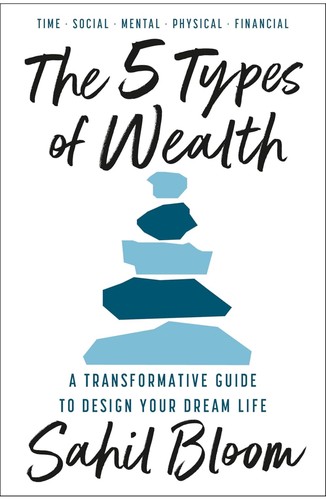
The 5 Types of Wealth
A framework for building a life rich in time, people, mind, body, and money — not just money.
by Sahil Bloom · 2025
Share on XBloom argues that treating money as the only form of wealth is a category error, and lays out five distinct types — Time, Social, Mental, Physical, and Financial — that together determine whether a life actually feels rich, not just looks rich on paper.
The book blends personal narrative, built around his grandfather's example, with research-backed frameworks and worksheets for each dimension, aiming to give readers a practical audit of where their life is over-indexed on money and under-indexed on everything else.
Much of the underlying advice — protect your time, invest in relationships, take care of your body — will be familiar to anyone who has read the broader self-improvement shelf; the value here is less in novelty and more in the clean five-part structure that makes the ideas easy to act on.
The grandfather framing does real work here — Bloom keeps returning to a life that was rich in time, relationships, and health but modest in financial terms, using it to push back against the implicit assumption that financial wealth should be optimized first and the other four will sort themselves out later. The worksheets are more useful than most self-help exercises because they force a specific tradeoff question (what are you spending this dimension of wealth on, right now) rather than a vague aspiration.
Key ideas
- Treating money as the only form of wealth is a category error — Time, Social, Mental, Physical, and Financial wealth together determine whether a life actually feels rich.
- Financial wealth is the easiest to measure, which is exactly why it's easy to over-optimize at the expense of everything else.
- The grandfather framing — a life rich in time, relationships, and health but modest financially — pushes back on the assumption that financial wealth should be optimized first.
- The worksheets force a specific tradeoff question (what are you spending this dimension of wealth on right now) rather than a vague aspiration.