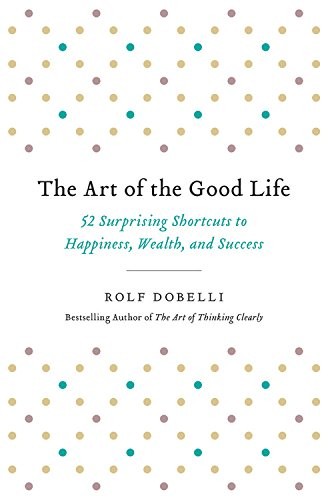
The Art of the Good Life
52 shortcuts to a better life, built on avoiding bad decisions.
by Rolf Dobelli · 2017
Share on XDobelli's follow-up applies the same catalog approach to something harder to pin down than cognitive bias: what actually makes a life go well.
Across 52 short chapters, he leans on a "via negativa" logic borrowed loosely from Nassim Taleb — the idea that avoiding stupidity is more reliable than chasing genius, and that removing bad decisions does more for a good life than adding good ones. Topics range from career choices and social comparison to how much of what we call meaning is really just narrative imposed after the fact.
It's less rigorous than "Thinking Clearly" and leans more on personal philosophy than research, so readers looking for hard evidence behind each chapter may find it thinner than the first book. Treat it as a set of provocations rather than an instruction manual.
The via-negativa framing does more work than it first appears — Dobelli isn't just saying 'avoid mistakes,' he's making a specific asymmetry argument: a single catastrophic decision (a ruinous investment, a reputation-destroying choice) can erase years of accumulated good decisions, while no single good decision buys equivalent protection, which is why he argues subtraction beats addition as a life strategy even though addition feels more proactive and satisfying.
Key ideas
- Dobelli applies the same catalog approach from Thinking Clearly to something harder to pin down: what actually makes a life go well.
- One catastrophic decision can erase years of good ones — which is why avoiding mistakes matters more than chasing wins.
- The "via negativa" logic, borrowed loosely from Nassim Taleb: avoiding stupidity is more reliable than chasing genius.
- It's less rigorous than Thinking Clearly and leans more on personal philosophy than research — treat it as provocations, not an instruction manual.