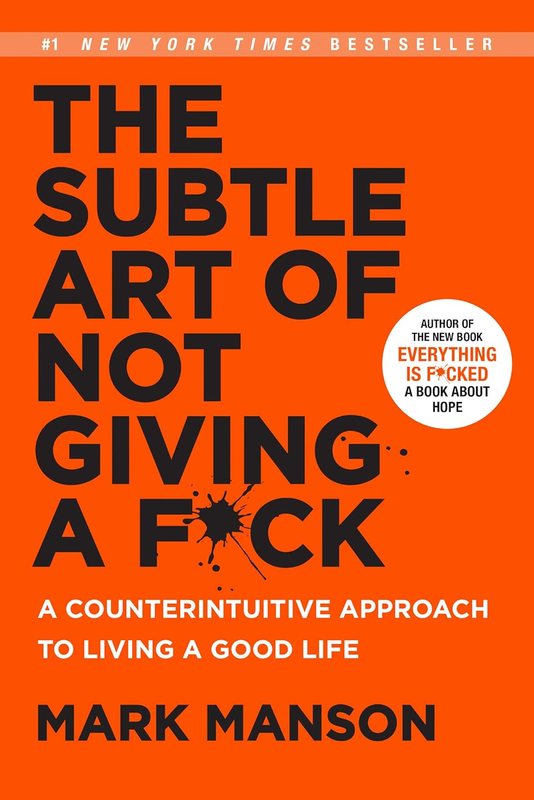
The Subtle Art of Not Giving a F*ck
Choosing your struggles deliberately instead of chasing endless positivity.
by Mark Manson · 2016
Share on XMark Manson's central argument is a deliberate inversion of most self-help: the constant chase for more positivity and more things to care about is itself the problem, and the real skill is choosing — carefully and narrowly — what actually deserves your finite supply of caring, and ruthlessly not caring about the rest.
The idea that's traveled furthest is his 'backwards law' — that the more you desperately want a positive experience, the more its absence becomes the thing you notice, and that pursuing comfort directly tends to produce more suffering than accepting discomfort as normal.
The blunt, profanity-laced voice is a deliberate contrast to typical self-help positivity — it's landed Manson both a huge readership and a fair amount of criticism for oversimplifying genuinely complex psychological ideas.
Manson's more serious point, underneath the deliberately crude framing, is that caring is a finite resource and most people spend it reactively — on other people's opinions, on minor inconveniences, on manufactured outrage — rather than deciding in advance what actually merits it. The backwards law extends this: chasing positive feelings directly tends to backfire because it keeps drawing attention to their absence, while accepting negative experiences as a normal cost of a meaningful life tends to reduce their grip.
Key ideas
- The constant chase for more positivity and more things to care about is itself the problem — the real skill is choosing narrowly what deserves your caring.
- You don't run out of things worth caring about — you run out of caring, because you spent it on things that didn't deserve it.
- The "backwards law": the more you desperately want a positive experience, the more its absence becomes the thing you notice.
- The blunt, profanity-laced voice is a deliberate contrast to typical self-help positivity, which has drawn both a huge readership and real criticism.