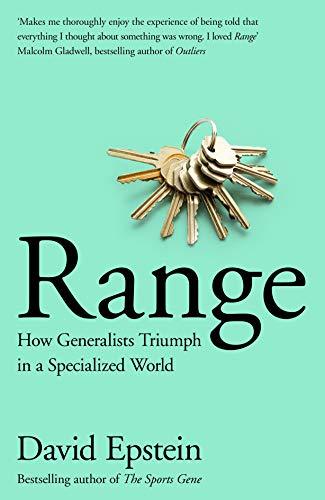
Range
Why generalists end up outperforming specialists in complex fields.
by David Epstein · 2019
Share on XDavid Epstein wrote Range as a direct rebuttal to the “10,000 hours, start early, specialize hard” narrative that’s dominated talent-development thinking for the last decade. His case, built from research across sports, music, science, and business: in complex, unpredictable (“wicked”) domains, breadth of experience often beats narrow early specialization — the sampling period generalists go through builds transferable pattern-recognition that specialists miss.
The Tiger Woods vs. Roger Federer framing that opens the book is the one everyone remembers — one sport from age two, one that sampled half a dozen before committing — but the strongest chapters are actually about professional judgment: how firefighters, forecasters, and doctors make better calls when they’ve had to think across contexts instead of drilling one.
It’s a genuinely well-argued counter-narrative, not a lazy contrarian take — Epstein engages seriously with when specialization does win (well-defined, stable-rules domains like chess or golf) before making the case for where it doesn’t.
Epstein's chapter on 'match quality' — how long it takes most people to find the field where their particular strengths actually fit — is the book's most practically useful idea, because it reframes years spent sampling different paths not as wasted time before 'real' specialization but as the actual mechanism by which people find work they're suited to. The firefighter and forecaster case studies back this up with something more than intuition: outcome data showing broad-experience judgment beating narrow expertise in genuinely unpredictable situations.
Key ideas
- In complex, unpredictable domains, breadth of experience often beats narrow early specialization — the "10,000 hours, start early" narrative doesn't hold everywhere.
- Years spent sampling aren't a detour before specializing — for a lot of people, they're how you find the right thing to specialize in.
- Firefighters, forecasters, and doctors make better calls when they've had to think across contexts instead of drilling one.
- Epstein engages seriously with when specialization does win — well-defined, stable-rules domains like chess or golf — before making the case for where it doesn't.