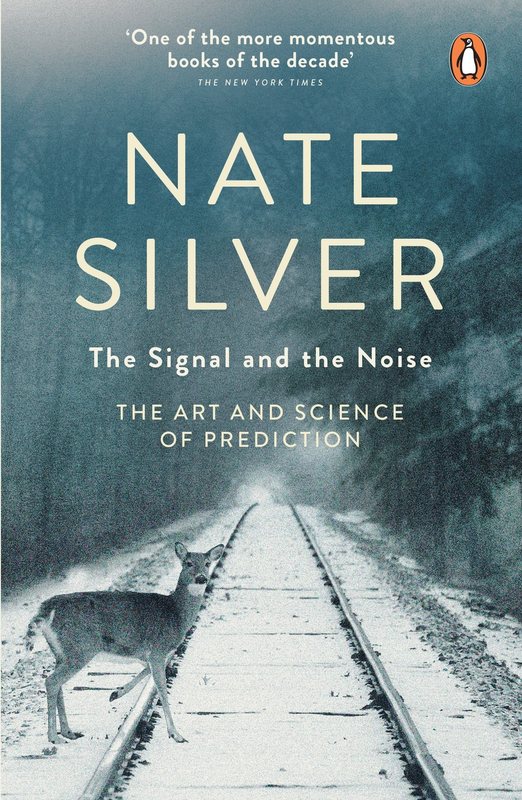
The Signal and the Noise
Why most predictions fail, and what separates good forecasters.
by Nate Silver · 2012
Share on XNate Silver's breakout book is a tour through why most forecasts fail, built from weather models, earthquake prediction, poker, baseball, and his own work calling elections. The throughline is a case for thinking probabilistically — treating a forecast as a distribution of outcomes with different likelihoods, not a single confident guess that's either right or wrong.
The chapter on weather forecasting is the one that reframes the most for casual readers: it’s a genuine success story of probabilistic thinking done right, and Silver uses it to show what separates a good forecaster (someone who’s honest about uncertainty and updates as new information arrives) from a bad one (someone who’s confidently, consistently wrong in one direction).
It holds up well over a decade later specifically because it’s not really about any one domain — it’s a mental model for updating beliefs under uncertainty that applies just as well to a football model as to a weather report.
Silver's baseball chapters are the clearest demonstration of what separates good forecasting from bad — he walks through how PECOTA (the player projection system he built) treats a player's future performance as a range of outcomes weighted by probability rather than a single number, and shows why that framing consistently outperforms scouts and pundits who state predictions with more confidence than the underlying uncertainty actually supports.
Key ideas
- Most forecasts fail because they're treated as a single confident guess rather than a distribution of outcomes with different likelihoods.
- A good forecast isn't a single confident number — it's an honest range, weighted by how much you actually know.
- Weather forecasting is a genuine success story of probabilistic thinking done right, in contrast to fields that still resist it.
- PECOTA, Silver's player projection system, treats future performance as a weighted range rather than a single number — and consistently outperforms scouts who overstate their confidence.
Notable quote: “The signal is the truth. The noise is what distracts us from the truth.” — Nate Silver