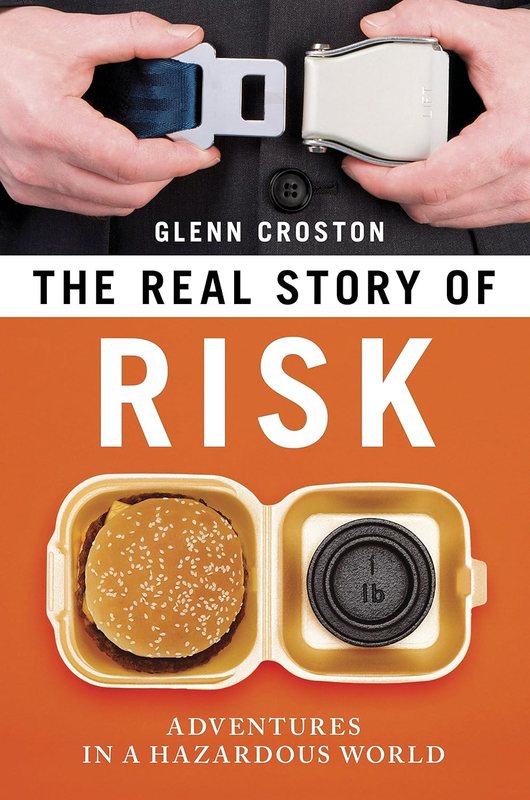
The Real Story of Risk
A tour of how badly humans misjudge real-world danger and probability.
by Glenn Croston · 2012
Share on XCroston, a biologist by training, traces human risk-misjudgment back to evolutionary mismatch — instincts built for ancient survival threats that misfire badly on the specific shape of modern risks.
The clearest example he uses: people fear rare, vivid dangers like shark attacks and plane crashes far more than common, slow-moving ones like heart disease, which actually causes roughly one in five deaths — because vivid narrative overrides statistical reality in how humans actually process danger, whether the topic is 401k allocation, food safety, or climate change.
It's general-audience risk psychology rather than sports or betting-specific, so the direct application to betting decisions is something you bring yourself — but the underlying lesson (your gut's sense of “risky” and the actual statistics frequently disagree) is exactly the trap every bettor on this shelf needs to watch for.
Croston's evolutionary framing does real explanatory work beyond the shark-attack example — he traces the specific ancestral logic behind why humans overweight vivid, sudden, agent-caused threats (an attack, a crash) over slow, statistical, cause-diffuse ones (diet, chronic disease, gradual financial erosion), because the first category was what actually threatened survival for most of human history and the second simply didn't exist in a form evolution had time to build instincts around.
Key ideas
- Human risk-misjudgment traces back to evolutionary mismatch — instincts built for ancient survival threats misfire badly on modern risks.
- Your instincts are calibrated for ancient dangers, not the statistical shape of modern risk — which is exactly why they keep getting modern risk wrong.
- People fear rare, vivid dangers like shark attacks far more than common, slow-moving ones like heart disease, which actually causes roughly one in five deaths.
- Vivid narrative overrides statistical reality in how humans process danger, whether the topic is investing, food safety, or climate change.