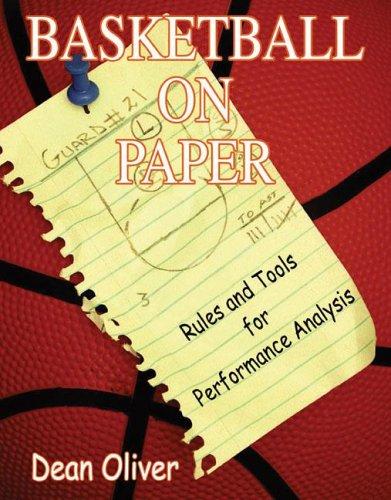
Basketball on Paper
The foundational stats framework for evaluating basketball performance.
by Dean Oliver · 2004
Share on XIf Moneyball popularized the idea of finding value with data, Basketball on Paper is where a lot of the actual math behind modern basketball analytics — offensive and defensive rating, possession-based efficiency, the Four Factors — got written down for the first time.
Oliver's central move is treating the possession, not the game or the box score line, as basketball's real unit of account, adjusted for pace and era so a fast, sloppy team and a slow, efficient one can be compared fairly — and from there he builds tools for isolating individual contribution inside a constantly-substituting, five-man sport that box scores were never built to measure cleanly.
It's denser and more equation-heavy than most books here, and it predates the three-point revolution that reshaped the sport it describes, which shows in some of its assumptions — Oliver's 2024 follow-up, Basketball Beyond Paper, updates a lot of that. Still, front offices cite the original two decades on for a reason.
The Four Factors framework holds up specifically because Oliver built it around a genuinely defensible claim — that effective field goal percentage, turnover rate, offensive rebounding rate, and free throw rate collectively explain the overwhelming majority of what separates winning and losing teams, which gave front offices their first quantitatively grounded checklist for diagnosing why a team was actually losing games, rather than relying on box-score totals that don't account for pace.
Key ideas
- Oliver treats the possession, not the game or the box score line, as basketball's real unit of account, adjusted for pace and era.
- Four specific, measurable factors explain most of what separates a winning basketball team from a losing one — everything else is mostly noise around the edges.
- Effective field goal percentage, turnover rate, offensive rebounding rate, and free throw rate collectively gave front offices their first quantitative checklist.
- It predates the three-point revolution that reshaped the sport it describes, which shows in some of its assumptions — Oliver's own 2024 follow-up updates a lot of that.