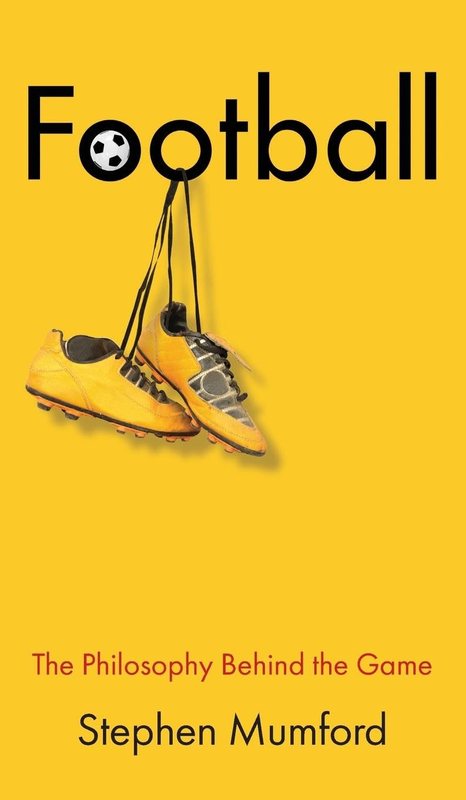
Football
A philosopher's look at what football reveals about meaning and aesthetics.
by Stephen Mumford · 2019
Share on XStephen Mumford is a philosophy professor at Nottingham, and this slim entry in Polity's “Little Books That Make You Think” series does something most football writing doesn't bother with: asking what football actually is, philosophically, rather than just analyzing how it's played.
Mumford works through questions like why a team can be “greater than the sum of its parts,” using Hegel to make sense of tactical evolution, and lands on a genuinely counterintuitive claim — that trying to manufacture beauty (flashy step-overs, showboating) tends to prevent it, while real beauty in football emerges as a byproduct of players simply pursuing victory as directly as possible.
It's closer to a long philosophical essay than a sports book, and deliberately short — don't expect data or tactics diagrams, this is about the “why” underneath the game rather than the “how.”
Mumford's Hegel detour is doing real philosophical work, not just decoration — he uses the idea of a whole being greater than the sum of its parts to explain why a tactically coherent team can beat a collection of individually superior players, treating a formation less as a static shape and more as a living argument between eleven people about how to solve a shared problem in real time.
Key ideas
- Asking what football actually is, philosophically, is a different project than analyzing how it's played — and most football writing skips it entirely.
- A football team isn't eleven individual performances added together — it's an argument about how to win that either resolves or doesn't.
- Trying to manufacture beauty (flashy step-overs, showboating) tends to prevent it; real beauty emerges as a byproduct of pursuing victory directly.
- It's closer to a long philosophical essay than a sports book — don't expect data or tactics diagrams.