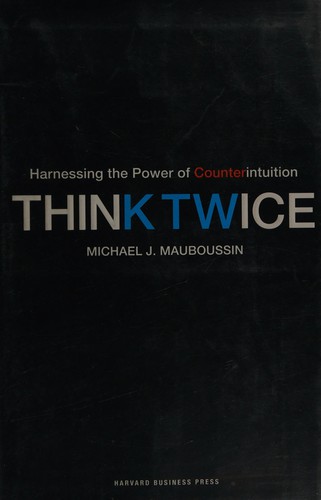
Think Twice
A field guide to the decision traps that catch smart, experienced people.
by Michael J. Mauboussin · 2009
Share on XMauboussin, a longtime investment strategist, catalogues the recurring decision-making traps that snare smart, experienced people specifically — overconfidence from past success, mistaking correlation for causation, anchoring on the wrong reference class — and offers concrete, checklist-style habits to counteract each one.
It's shorter and more applied than the denser behavioral-economics literature, aimed at practitioners who need usable tools rather than a full theory of cognition.
Because it's structured as a series of distinct traps, it can read a little like a checklist rather than a flowing argument, and Mauboussin's finance background means many examples lean toward investing — though they translate reasonably well to betting and forecasting.
Mauboussin's chapter on the 'inside view versus outside view' is the one with the widest application beyond investing — he shows that people systematically underrate how useful it is to ask how similar situations turned out for other people instead of reasoning purely from the specifics of their own case, a habit that's directly transferable to betting, forecasting, and any decision made under real uncertainty.
Key ideas
- Mauboussin catalogues the recurring decision-making traps that snare smart, experienced people specifically — overconfidence from past success, mistaking correlation for causation.
- Asking how similar situations turned out for other people beats reasoning purely from your own case — and almost nobody does it by default.
- The "outside view" — how did similar situations turn out for other people — is systematically underused compared to reasoning from your own specifics.
- It's shorter and more applied than a book like Thinking, Fast and Slow, aimed at practitioners who need usable tools rather than a full theory of cognition.